
Project J.A.R.V.I.S.
Autonomous Agent Orchestration with n8n
The Evolution from Automation to Autonomy
Standard workflow automation—moving data from Point A to Point B—is dead. The future belongs to systems that can think. In this case study, I break down exactly how I architected a sovereign AI agent, codenamed "Jarvis," utilizing the unparalleled orchestration power of n8n integrated directly with LangChain.
The Limitations of Legacy IF/THEN Workflows
For years, platforms like Zapier and Make have dominated the automation space. But they suffer from a fatal flaw: they require rigid, linear programming. If an API returns an unexpected error, a Zap breaks. It has no cognitive ability to self-correct.
To build a true Jarvis—an entity capable of executing open-ended tasks like "Research our top 3 competitors and write a differentiated landing page"—I needed a system that could dynamically choose its own tools, access long-term memory, and run iterative reasoning loops.
The Technical Architecture of Jarvis
This is where the magic of n8n comes in. Unlike rigid platforms, n8n allows for the visual orchestration of highly complex, looping data structures.
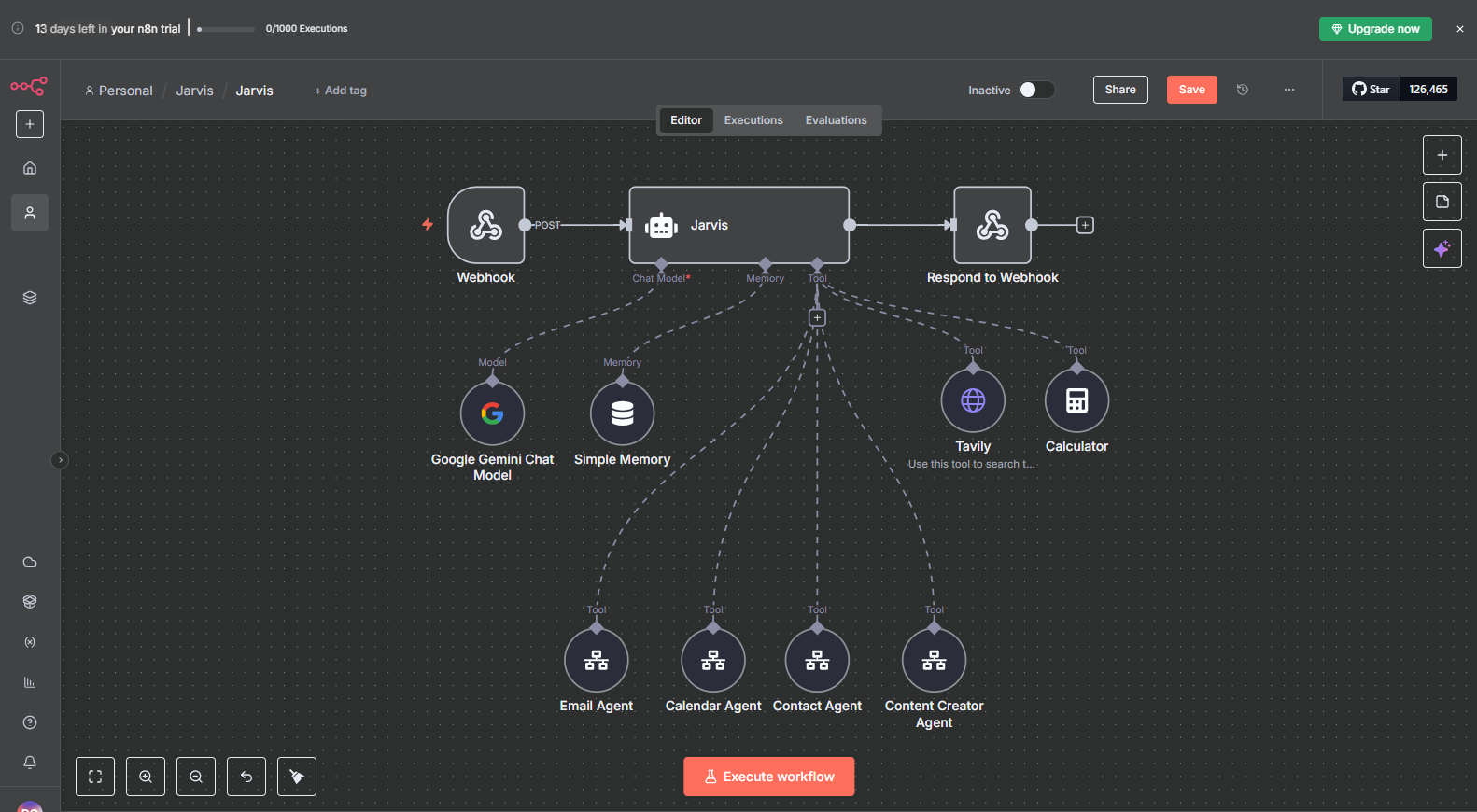
- The Cognitive Engine (LangChain): LangChain serves as the brain. It provides the framework for the ReAct (Reasoning and Acting) loop. When a user inputs a command, LangChain parses the intent and decides which specific Tool is required to solve the first step of the problem.
- The Nervous System (n8n): n8n acts as the central nervous system, housing the webhooks, API authentications, and the physical routing logic. It allows the LangChain agent to effortlessly reach into external environments (like Gmail, Stripe, or a headless browser scraper).
- Long-Term Memory (Pinecone): To prevent the agent from acting like an amnesiac, it is connected to a Vector Database. This allows Jarvis to recall previous conversations, internal company documents, and historical preferences, dramatically increasing contextual accuracy.
Self-Healing Execution
The most profound feature of this architecture is its capacity for self-healing. When Jarvis attempts to scrape a website and the CSS selector fails, the try/catch logic inside n8n doesn't just throw an error to the user. Instead, it feeds the failure notice back into the LangChain LLM. The AI realizes the tool failed, formulates a new strategy (e.g., using a different search engine or a generalized text-extractor), and tries again.
This fundamentally shifts the paradigm from human-in-the-loop debugging to zero-touch autonomous execution.
Q&A: Core Infrastructure
Why build this in n8n instead of pure Python code?
While pure code offers ultimate flexibility, n8n provides a visual orchestration layer that makes managing API integrations, OAuth tokens, and complex branching logic infinitely faster and more stable in a production environment.
How does Jarvis access the internet?
Within the n8n workflow, I supply the LangChain agent with a specific "SerpAPI Tool" and a "Web Scraper Tool." The LLM natively understands how to format the JSON requests to trigger these nodes when its reasoning loop determines it needs live data.